Audio previewsummary of this post
There is an image that resurfaces on social media sometimes, sourced from one or two archives which host it, of a young American Indian woman. The archives note her name as O-o-dee, of the Kiowa people, the picture taken shortly before the turn of the previous century.
The girl is wearing traditional finery, with other garments nearby; she has jewelry which also looks traditional, and on her feet are moccasins, but what stands out is the natural smile, so unlike most of the images we see from that era. Between the slow pace of exposure, missing teeth, and a general gravity in having your likeness taken, into the 20th century it was less common to pose naturally or smile for posterity.
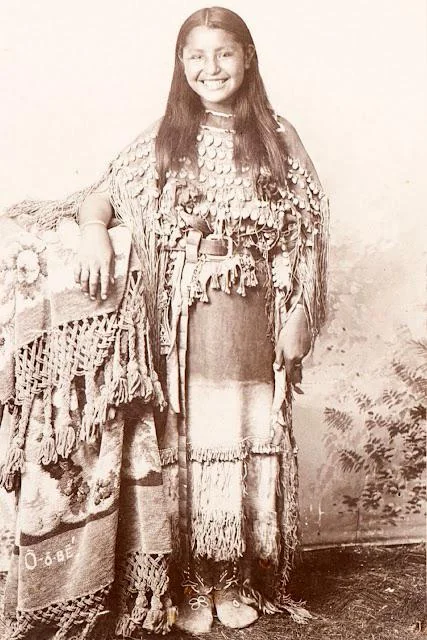
O-o-dee, of the Kiowa people, smiling.
Viewed from the head up, this could be any girl anywhere — a tidy reminder of what is common in humanity. But it also raises a question: is it real?
This image could easily be an AI-generated artifact; it took only a few minutes to generate a reasonably comparable replica with AI as a kind of verification (see below). As discussed elsewhere, the need for doubt is not a net negative — the burden of proof for reality needs to be associated to something deeper than pixels. The latter half of the 20th century, and the beginning of the 21st, enjoyed a relatively rare phenomenon in facts and truth being well represented by the stories and images in circulation. Historically, it was a brief moment of whimsy — anything on the TV screen or on paper had a reasonable chance of being reasonably accurate to reality. In the clarity of hindsight, it is improbable for a situation like that to endure. Maybe we’ll find a way back to it. For now, it’s a mindset we ought to reject to survive. The existence of an image so clearly representative of something real, and yet so dubious as an artifact, motivates interpretation of every visual that we encounter.
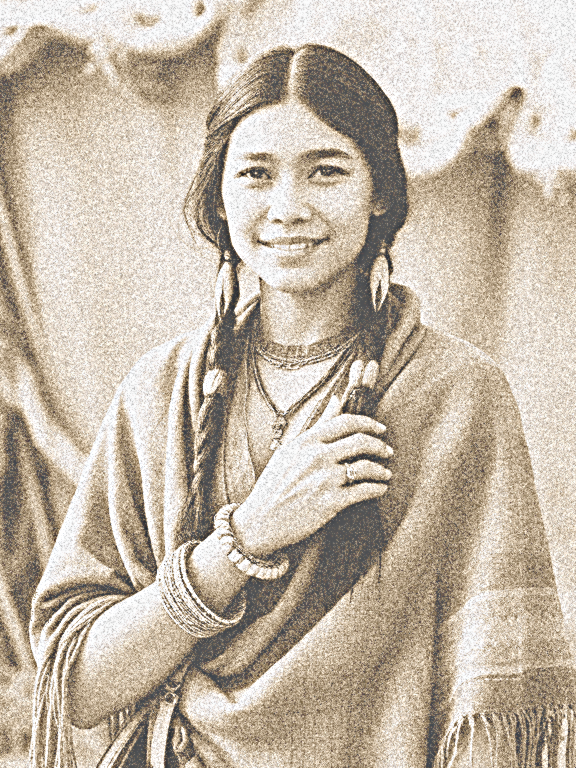
No-o-dee, of the AI-generated people, smiling.
There’s something curious about this middle ground of duplicative ability, unlike the use of AI technology to mislead or tell lies. The story of a young Kiowa woman in the 19th century is a real story, regardless of whether this image depicts a real girl or not. It is a new kind of old storytelling, closer to lore than to depiction. The image may represent something that precisely was, or it may represent a concept, manifested. Either way it is used to tell something to the viewer. In informal ways this usage is rising in use. YouTubers telling the story of a historical event use AI imagery to supplement repetitive stock photographs and gaps in historical archives. This too is not necessarily a negative, for there’s much to be gained in applying it artfully — but it does require a different symbology for visual imagery.
In the case of this particular photograph, the image is not new. Its existence online precedes generative AI. Many digital denizens remember seeing it long before we could generate something like this outside of expert use of graphics tools. Here, memory does the talking. What a handful of people recall can be convincing. For those who have not seen the image before, they can choose to believe the claim of someone who says they knew this image before generative AI, or not; belief in the claim is as equivocal as the image itself.
This is the crux of the determination: what sources distinguish truth? For a while an image itself told mostly truth. This failing, another individual may tell you the truth, but they also might lie — lying is not a new phenomenon. And if the ones who might claim the image to be true are lying, or if a point is reached where none remember, what representation or knowledge of reality reflects that this image is a factual representation? What convinces us? Should anything convince us?
The question is treated side-wise in the classic book 1984. In it, in order to maintain total control over heart and mind, the Party often requires of its members a retroactive amendment of data to correspond with the current iteration of “the truth.” Since the Party is at war with Eurasia now, they must always have been at war with Eurasia, and any material that might contradict this must be wrong, and therefore altered, even if the material was written at a time when this fact was not yet factual. The task repeats with every change.
In the end only the memory of the individuals who made the change, or those few who remember the fact in question before it was altered, retain the truth — the original, actual truth. But the Party goes further — in order to fully actualize Newthink, one must be able to enjoy the contradiction itself. Winston, the main character, must know that he is changing the facts written in a book, and simultaneously accept that the new fact has always been the correct fact. The members of the Party are obligated to embrace the dissonance in their own minds. And even if they did not — as Winston attempts — it will before long get lost in the deluge of altered information.
1984
In the real world we are fortunate and generally can avoid drastic measures in seeking facts and truth. But when memory fails, when individuals age and pass on, only records represent truth — digital, physical, and in story. But stories change, too, and physical objects, even when unaltered, are available only to a few, and then those who have seen them must be trusted. Though distribution of media greatly predated the digital age, it was principally in the 20th century, with cheaper reproduction of photographs on paper, that evidence became generally available outside of physical appropriation. All the more so in the digital age — you see a scanned image, so you don’t need to track down the physical image to know what it represents. You trust the chain of execution — image owner, to scanner, to storage, to medium of sharing, to your own screen.
What remains when the purity of this chain becomes uncertain is more nebulous. The facts still exist — and thanks to modern tools assessing this is often much easier than it ever has been. We can note the dates and records of posts, metadata associated to files; digital forensics can often audit the trail of data or identify if any alterations have been performed; data catalogs share common features which correlate to confirm or deny a certain piece of truth. The means to gather information about information is a great help in the face of new uncertainties. But if it is help, it is not absolute vindication. All data can be altered, with some degree of difficulty, and if the more insidious alterations require effort, verifying also requires more effort. Verification processes like blockchain add a layer of confirmation, but this cannot always be applied or confirmed. Many audit trail technologies require cooperation from creation to validation, which can be unrealistic.
Fortunately, for now, we can be satisfied that most images are posted in good faith, much as most stories person to person are communicated in good faith. The great fears of influence and misdirection through AI in recent elections turned out to be far less damaging than feared, and for exactly the reason of good faith– the chain of trust has little to do with the medium. If I can trust my neighbor, the impact of nefarious actors falls short.

The state of things seems cautionary but promising. The digital media with which we have become so comfortable represent very little integrity. Outside of niches and internal networks, digital artifacts may become dilute, or trivial. Yet in many ways communal data sharing has been the purpose of digital communication since ARPANet became the Internet and communication moved from official research data to hobby data of enthusiasts. The exchange of data is to connect, rather than to directly inform. Learning and verification still occur in this paradigm, but with healthy skepticism. The debates continue, and we retain our relationship of trust tied to physical reality. Trust relies on individuals, and individuals have not changed, fundamentally. Nefarious actors and disguised data take a new form but the pose same old danger. We are at no greater risk as long as we stick to what we have always done best, as a species — forming groups and associations that create deep trust, and collaborate toward certainty.
So where does that leave us, with a picture of a young smiling Kiowa on social media and no idea if it really happened? Wondering is enough, enjoyment is enough, and if it sparks a curiosity, and a small journey to learn about the Kiowa, and the girl whose beaming face represents her buried culture — then we’re better off than we ever were when those pixels meant everything.